
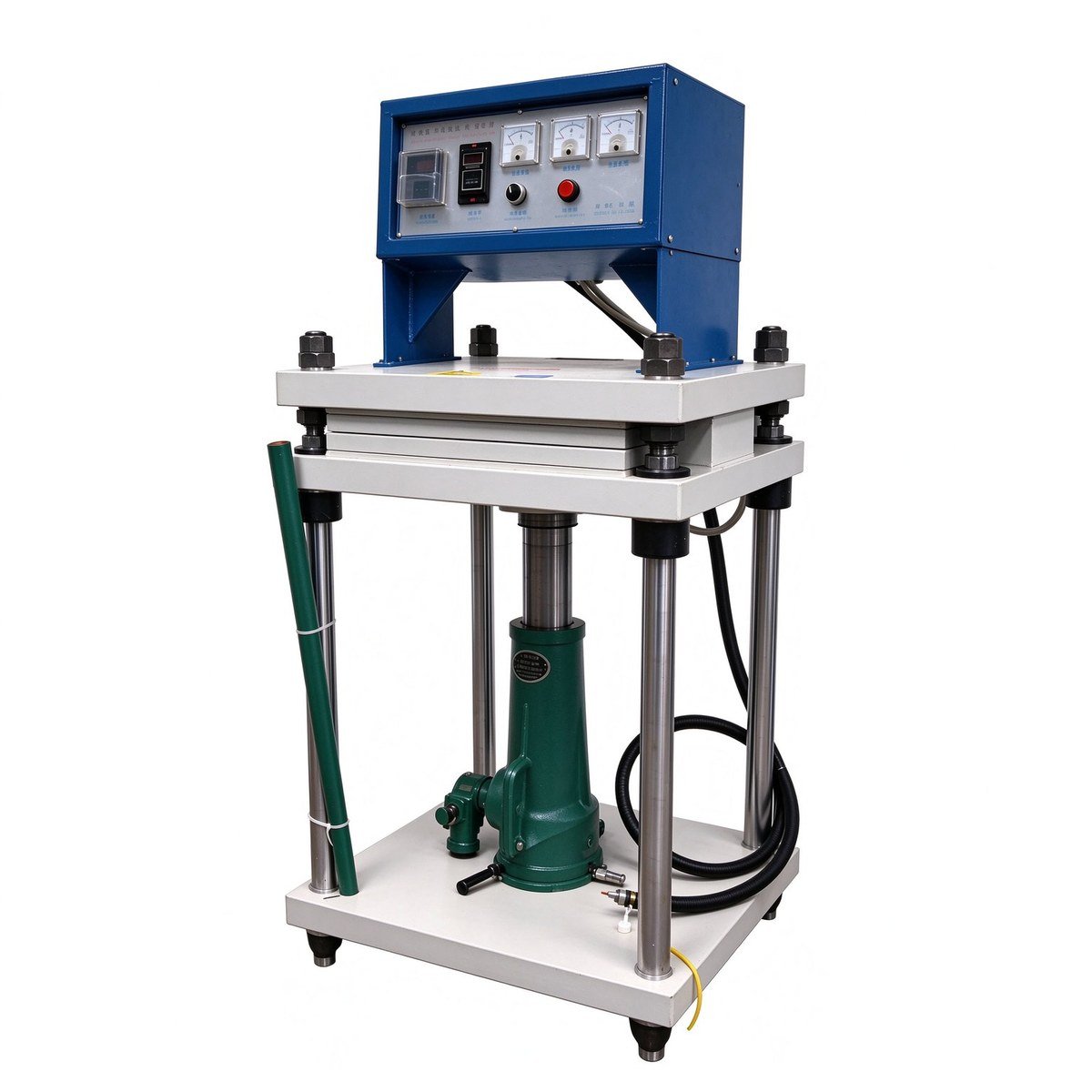
Every spin casting shop lives or dies on its rubber moulds. This hydraulic press is the machine that makes them: raw silicone sheet is laid over the master pattern, the platens close under pressure, and the rubber is held at 150 – 180 °C until it vulcanises into a mould that reproduces the pattern down to the finest texture.
The frame is a four-column, bottom-up clamping design with two ground steel heated platens. Heating is split into three independently controlled zones, so the top platen, the mould body and the bottom platen each hold their own set point instead of one zone dragging the others off temperature. Clamping pressure comes from a manual hydraulic hand pump — no pump motor, no electric valve, nothing to burn out; the check valve holds the pressure for the whole cure, and a gauge on the pump shows exactly what you applied.
It is built for spin casting moulds from 12 inch up to 20 inch, which covers the full range of our centrifugal machines. Five platen sizes are stocked, and each one is sized with clearance around the nominal mould diameter so the rubber has room to spread under pressure.
Sizes and specifications
| Mould size | Platen (mm) | Clamping force | Heating power | Net weight |
|---|---|---|---|---|
| 12 inch (305 mm) | 350 × 350 | 10 t | 2.2 kW | approx. 120 kg |
| 14 inch (356 mm) | 400 × 400 | 12 t | 3.0 kW | approx. 150 kg |
| 16 inch (406 mm) | 450 × 450 | 15 t | 4.0 kW | approx. 190 kg |
| 18 inch (457 mm) | 500 × 500 | 20 t | 5.0 kW | approx. 230 kg |
| 20 inch (508 mm) | 550 × 550 | 25 t | 6.0 kW | approx. 280 kg |
Main parameters (common to all sizes)
| Machine type | Hydraulic vulcanizing press for silicone (rubber) moulds |
|---|---|
| Structure | Four-column frame, single daylight, bottom-up clamping |
| Ram stroke | 150 mm |
| Daylight opening | 150 mm (mould plus backing plates) |
| Platen heating | Electric, three independently controlled zones |
| Max platen temperature | 300 °C |
| Working temperature | 150 – 180 °C for silicone vulcanising |
| Temperature control | PID, ±2 °C |
| Hydraulic system | Manual hand pump, 14 MPa working pressure |
| Pressure indication | Gauge fitted on the pump body |
| Timer | Digital, with audible end-of-cure alarm |
| Power supply | 220 V single phase (380 V 3-phase version on request) |
| Platen surface | Ground steel, parallel machined |
| Warranty | 12 months on the frame and the electrical package |
Built for
- Spin casting rubber moulds from 12 to 20 inch, for our centrifugal machines
- AB glue moulds and two-part silicone moulds for jewellery and hardware
- Silicone keypads, gaskets and small technical rubber parts
- Pattern shops that need to prove a mould before committing to a production run
How a mould is made on it
- Prepare the pattern — the master is fixed to the bottom plate and the frame walls are built around it.
- Fill with silicone — uncured silicone sheet is packed over the pattern; the amount is set by the mould volume, not by guesswork.
- Close and pressurise — the platens close and the hand pump is worked up to the pressure on the gauge. The check valve holds it.
- Cure — the three zones hold 150 – 180 °C for the set time; the timer alarms when the cure is done.
- Cool and strip — pressure is released, the mould is taken out and the pattern is pulled, leaving the cavity ready for the casting machine.
Why a hand pump instead of a motorised hydraulic unit
- Nothing to fail electrically — no pump motor, no solenoid valve, no pressure switch; the pressure you apply stays applied through the whole cure.
- Cheaper to buy and to keep — the money goes into the platens and the temperature control, which is what decides mould quality.
- Fine control on small moulds — you feel the resistance and stop exactly where you want, which matters when the pattern has thin walls.
- Right-sized for the job — a mould shop makes a handful of moulds a week, not a hundred a shift; a motorised unit would sit idle.
- Easy to service anywhere — seals and a hand pump are stock items in any hydraulic shop.
What is included
- Press, hand pump with gauge, and the electrical control box
- Three-zone PID temperature control, pre-set and tested before dispatch
- One set of backing plates matched to the platen size
- Operating manual and a starting cure schedule for common silicone hardnesses
- Export packing (plywood case) and sea freight quoted separately
Ask for a quotation
Tell us the mould diameter you need and the silicone you use, and we will confirm the right platen size, the cure schedule and the shipping cost to your port. Prices shown are ex-works Dongguan; export packing and freight are quoted on top.