
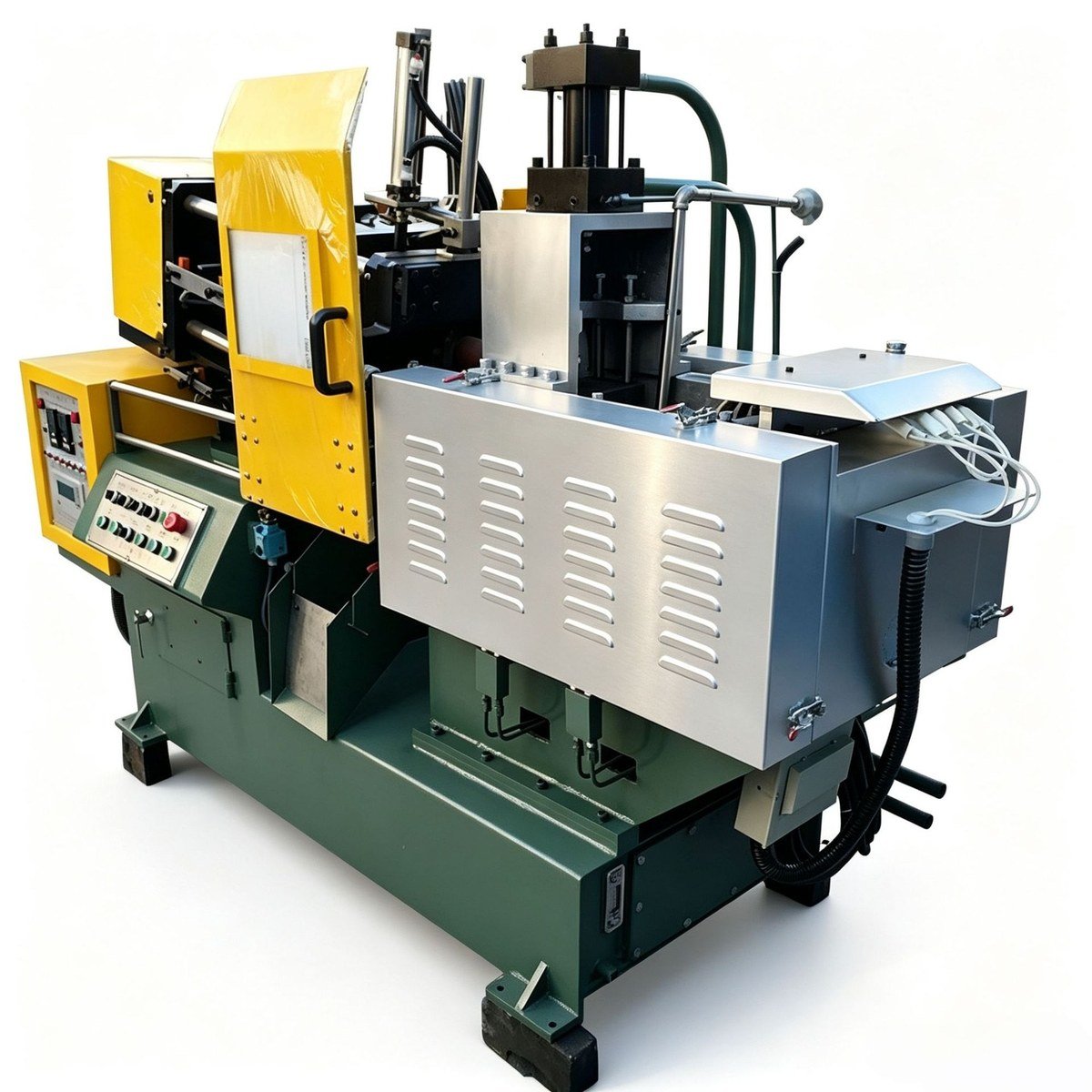
The 168T Hot Chamber Die Casting Machine is the step above our 88 T frame: clamping force for genuinely large zinc parts, platen space for thick multi-cavity dies, and a crucible that keeps the melt level stable through a long shift. It is a hot chamber machine in the classic sense — the gooseneck sits inside the melt, so metal reaches the die without a transfer ladle, without temperature drop and with almost no oxide pickup. For parts that get plated, that difference shows up directly in polishing hours.
What this size buys you is not just force. The 168T Hot Chamber Die Casting Machine runs dies up to 520 mm thick on 720 × 770 mm platens, and the 480 kg zinc crucible means the metal level barely moves across eight hours of casting — level swing is a quiet cause of short fills that nobody traces until the scrap rate climbs.
Built for
- Faucet bodies, valve bodies and sanitary fittings
- Door locks, lock bodies and smart-lock front panels
- Luggage hardware, buckles, bag frames and decorative fittings
- Lighting bases and lamp housings
- Automotive interior trim and small structural zinc parts
- Multi-cavity dies where per-cycle output decides the unit cost
Why this size pays for itself
A 168 T frame is where single-cavity work stops making sense. On a faucet body or a lock housing you can run four to eight cavities in one die, cut the runner weight per part, and still hold the plating-quality surface that hot chamber zinc is bought for. The 108 kN shot force with a 60–70 mm plunger covers the mid-weight range without going to a machine that needs a bigger power supply and a bigger crane.
Main parameters
| Machine type | Horizontal hot chamber, zinc injection |
|---|---|
| Clamping force | 1,680 kN (168 t) |
| Clamping / opening stroke | 350 mm |
| Die thickness range | 200 – 520 mm |
| Platen size | 720 × 770 mm |
| Space between tie bars | 486 × 486 mm |
| Tie bar diameter | 85 mm |
| Ejector force / stroke | 108 kN / 85 mm |
| Shot (injection) force | 108 kN |
| Shot stroke | 150 mm |
| Plunger diameter | 60 / 65 / 70 mm |
| Shot weight, zinc | 2.1 / 2.4 / 2.86 kg by plunger size |
| Shot position | 0 / −80 mm |
| Crucible capacity (zinc) | about 480 kg |
| Motor power | 15 kW |
| Hydraulic working pressure | 14 MPa |
| Electric furnace | 30 kW |
| Nozzle heating power | 2.5 kW |
| Oil tank | 300 L |
| Machine weight | about 6,150 kg |
| Dimensions (L × W × H) | about 4,850 × 1,600 × 2,270 mm |
| Power supply | 380V, 3-phase, 50 Hz (440V / 60 Hz optional) |
Values are the standard configuration for this frame size. Plunger diameter, shot weight and die thickness are fixed against your part drawing when we quote — send the drawing and we confirm the exact set-up, including cavity count and expected cycle time.
168T or 188T — which one do you need?
The 188T machine is the same frame with 200 kN more clamping force, a taller die space and a bigger shot — choose it when your parts push past about 2.4 kg of zinc per shot or your dies are thicker than 520 mm. For everything under that, the 168T does the job on less power and less floor space. The two frames share tooling logic, so a die built for one can be re-cut for the other without redesigning the part.
Where it sits in the range
Smaller zinc parts and lead work run more economically on the CK 88T hot chamber machine; aluminium and high-melting alloys need the cold chamber range. If your part mix spans several sizes, we quote the line as a package rather than single machines.
Turnkey delivery
- Mould design and manufacturing matched to your part drawing
- Installation, commissioning and trial production in your workshop
- Operator training and a written process parameter sheet
- Spare parts package and lifetime remote technical support
Ask for a quotation
Send the part drawing (or a sample photo), the alloy (Zamak 3 or 5) and your target output per shift. We reply with the right frame size, mould cost, cycle time and delivery schedule — usually within one working day.