
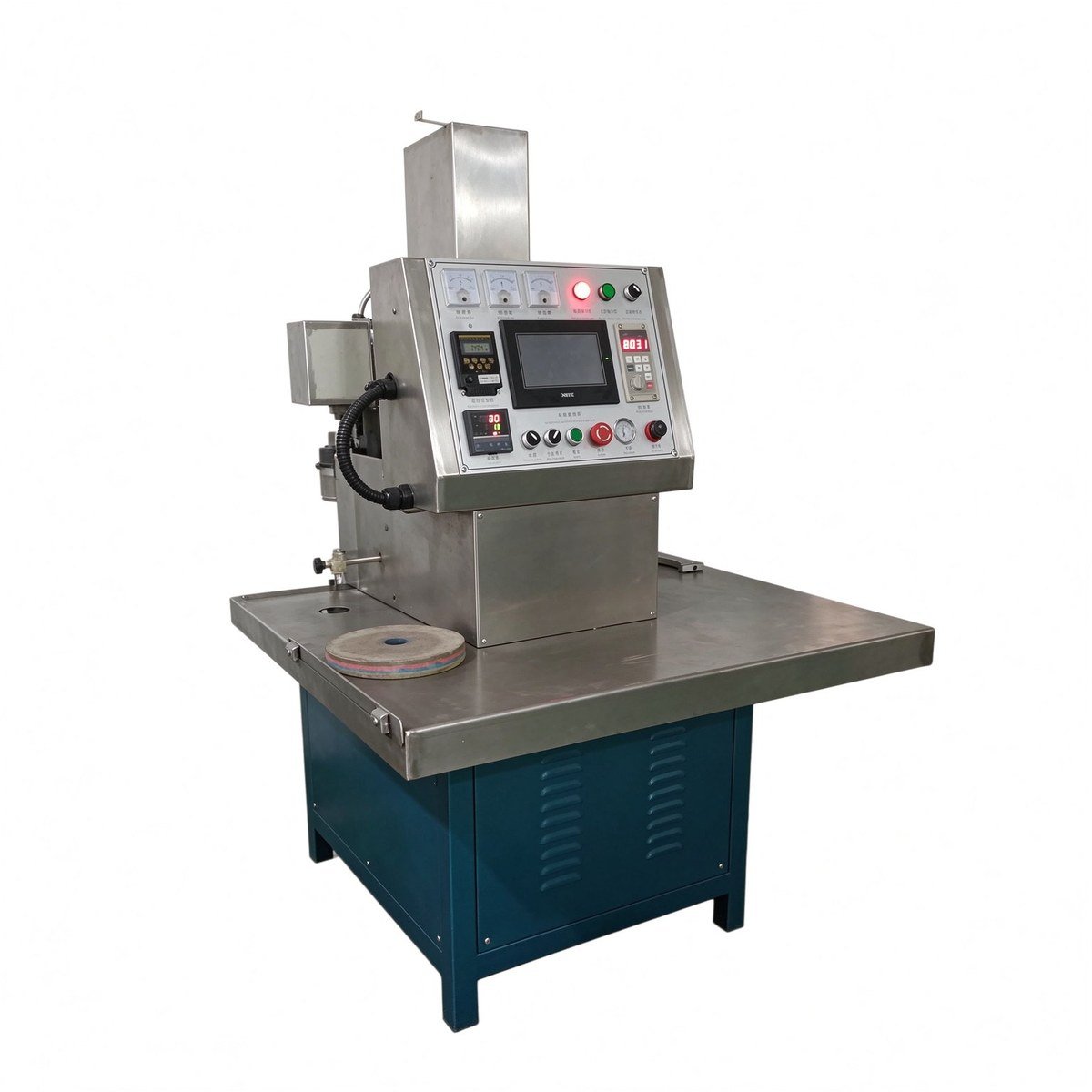
This is a fully automatic centrifugal spin casting machine with the melting furnace built into the same base — one compact unit that melts, doses, spins and finishes each shot without an operator lifting a ladle. The stainless steel top table carries the mould station; the furnace, the pneumatic dosing system and the drive sit below it, so the whole casting cell occupies about 1.5 m² of floor and can be moved with a pallet truck.
The operator’s job is reduced to placing a rubber mould on the station and pressing start. The PLC checks that a mould is present (an empty station is skipped automatically), brings the crucible to the set pouring temperature, injects a preset dose of metal into the spinning mould, holds the spin for the programmed time and then releases the mould for cooling. Recipes are stored per mould, so switching from one product to another is a matter of calling up a number rather than re-setting the machine.
Built for
- Zinc alloy (Zamak 3 / Zamak 5) jewellery, buckles and garment hardware
- Pewter, tin and lead alloy giftware, figurines and souvenirs
- Belt buckles, badges, medals and keychains
- Small decorative castings and fittings produced in rubber moulds
Main parameters (typical)
| Machine type | Automatic centrifugal (spin) casting, furnace integrated |
|---|---|
| Spin speed | 50 – 1400 rpm, stepless, set in 10 rpm steps |
| Spin direction | Clockwise / counter-clockwise selectable |
| Mould diameter | 9″ – 12″ (230 – 300 mm) |
| Mould thickness | 0 – 120 mm |
| Mould stations | Single station, automatic mould detection |
| Crucible capacity | approx. 180 kg (zinc alloy) |
| Melting | Electric resistance furnace, built into the machine base |
| Max melt temperature | 600 °C (typical pour 420 – 450 °C for Zamak) |
| Temperature control | PID, ±5 °C |
| Injection | Pneumatic dosing, 0 – 7 kg/cm² adjustable |
| Control system | PLC + colour touchscreen, multi-recipe memory |
| Mould cooling | Built-in forced-air fan at the mould station |
| Power supply | 16 kW, 380 V / 3-phase / 50 Hz (440 V 60 Hz on request) |
| Dimensions | approx. 1250 × 1250 × 1450 mm |
| Machine weight | approx. 700 kg |
| Output | approx. 60 – 120 castings per hour, depending on mould |
How the automatic cycle runs
- Load — the rubber mould is placed on the station; the sensor confirms it is seated.
- Melt — the integrated resistance furnace holds the alloy at the preset temperature under PID control.
- Dose — a pneumatic cylinder injects the programmed shot weight through the heated feed tube, so the metal enters the mould without passing through cold air.
- Spin — the table accelerates to the recipe speed (50 – 1400 rpm, set in 10 rpm steps) and holds it for the set time.
- Release — the mould is returned to the operator for cooling on the built-in fan, and the next cycle can start.
If your orders are short runs and the mould changes several times a day, the manual version of this machine costs less to buy and needs no recipe programming at all.
Why buyers choose this configuration
- Furnace and machine in one frame — no transfer ladle, no temperature loss between furnace and mould, no separate melting room.
- Repeatable shot weight — every casting gets the same dose, which cuts metal consumption and keeps part weight inside tolerance.
- Less oxidation — the heated feed tube keeps the alloy covered until it reaches the mould, so dross stays out of the cavity and the surface comes out brighter.
- One operator, several machines — the automatic cycle means the operator only loads and unloads, so a single person can run a bank of units.
- Built for long shifts — forced-air cooling of the mould station and a heavy-duty drive sized for continuous daily production.
Turnkey delivery
Every machine is supplied as a working line, not a bare machine:
- Rubber mould making — master pattern, vulcanising and first article approval
- Installation, commissioning and trial production in your workshop
- Operator training and a written process parameter sheet per product
- Spare parts package (feed tube, crucible, seals, heater elements) and lifetime remote support
Ask for a quotation
Send us the part drawing or a photo of the product, the alloy you cast and your target output per shift. We will reply with the right machine size, mould cost, cycle time and a delivery schedule — usually within one working day.