
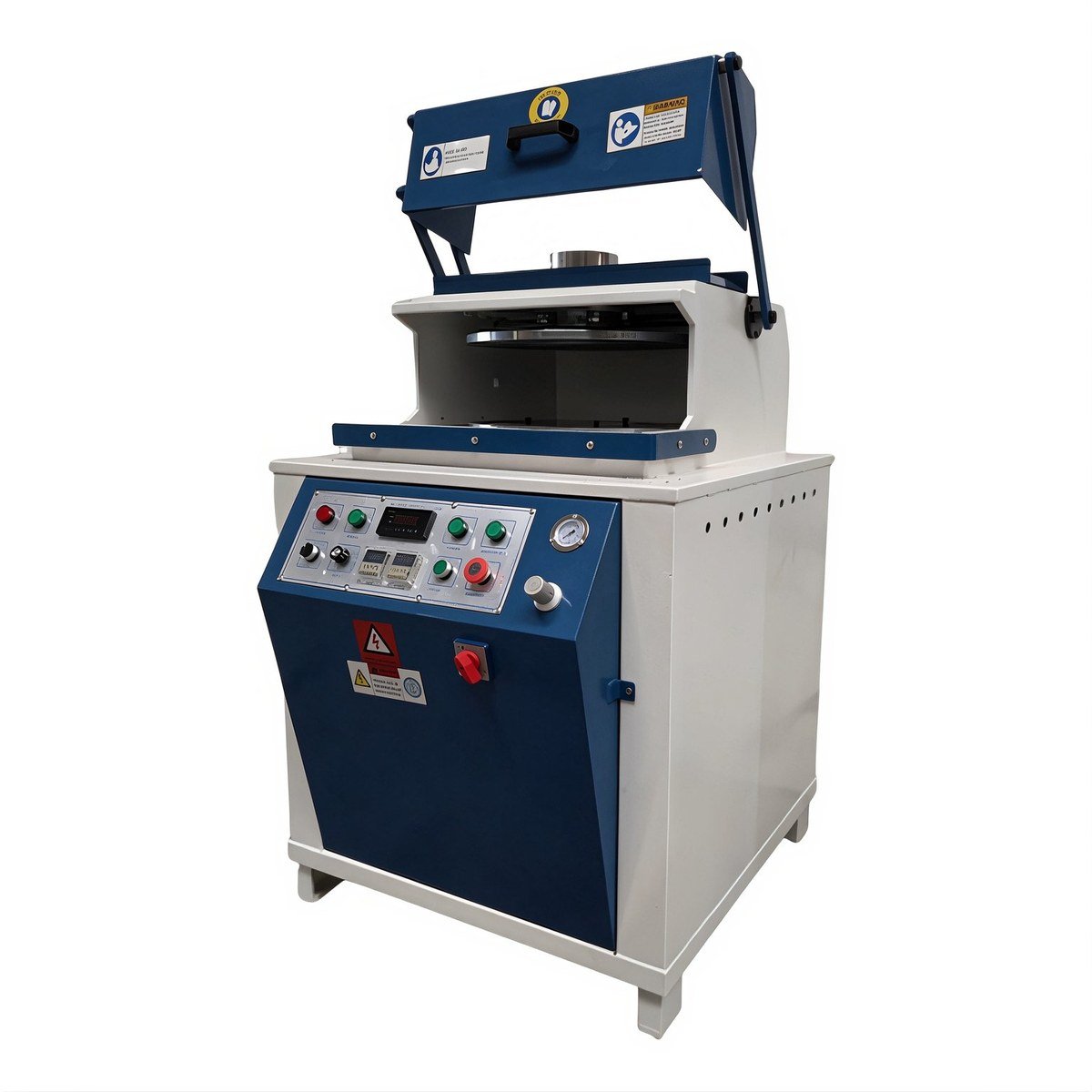
This semi-automatic machine casts under vacuum: the mould chamber is evacuated before the shot, then the table spins and the metal is injected into a cavity that has no air left in it. The result is the combination that matters on visible zinc and pewter parts — no gas porosity, tighter grain structure, sharper reproduction of fine detail — with a fill and a cooling time short enough to keep the cycle moving.
“Semi-automatic” here means the machine handles everything except loading: the lid opens and closes on pneumatics, the spin speed and spin time are typed into the digital panel and held exactly, the metal is dosed by a pneumatic cylinder at a set pressure, and an electronic brake stops the table instead of letting it coast. One operator loads the mould and takes the casting off — that is the whole job.
Built for
- Zinc alloy (Zamak 3 / Zamak 5) jewellery, buckles and garment hardware
- Pewter, tin and lead alloy giftware, figurines and souvenirs
- Badges, medals, keychains and small decorative fittings
- Rubber-mould casting shops moving up from a fully manual machine
Main parameters (typical)
| Machine type | Semi-automatic centrifugal (spin) casting, single mould station |
|---|---|
| Spin speed | 50 – 1400 rpm, stepless in 10 rpm steps, digital display |
| Spin timer | Digital, set per mould and stored for repeat runs |
| Mould diameter | 9″ – 12″ (230 – 300 mm); 14″ – 18″ on request |
| Mould thickness | 0 – 120 mm |
| Mould stations | Single station with automatic mould detection |
| Vacuum system | Fitted — rotary vane pump, 1.2 kW, 900 rpm |
| Crucible capacity | approx. 80 kg (zinc alloy) |
| Melting | Electric resistance furnace, PID controlled |
| Max melt temperature | 600 °C (typical pour 420 – 450 °C for Zamak) |
| Temperature control | PID, ±5 °C |
| Injection | Pneumatic dosing, 0 – 7 kg/cm² adjustable |
| Lid operation | Automatic pneumatic open / close |
| Safety | Dual interlock on the lid + electronic emergency brake |
| Air supply | 0.6 – 0.8 MPa compressed air required |
| Vacuum level | −0.01 to −0.06 MPa, adjustable |
| Drive power | spin motor 1.5 kW + vacuum pump 1.2 kW (total 2.7 kW) |
| Power supply | 380 V / 3-phase / 50 Hz (220 V single-phase on request) |
| Dimensions | approx. 900 × 800 × 1400 mm |
| Machine weight | approx. 200 kg (approx. 350 kg crated) |
| Output | approx. 60 – 120 casts per hour, depending on mould and alloy |
How the semi-automatic cycle runs
- Load — the rubber mould is placed on the table; the sensor confirms it is seated and positioned for balance.
- Close and evacuate — the lid closes automatically and the pump pulls the chamber down to the set vacuum.
- Spin and inject — the table ramps to the programmed speed and the pneumatic cylinder injects the set dose at the set pressure.
- Hold — the table keeps turning for the programmed time while the metal solidifies under vacuum.
- Brake and unload — the electronic brake stops the table, the lid lifts and the mould comes off for the cooling bench.
What the vacuum actually buys you
- No gas porosity — air is removed before the metal arrives, so voids cannot form in thick sections or at the far end of a long cavity.
- Sharper detail — metal fills fine texture, lettering and undercuts that trap air on a non-vacuum machine.
- Less flash — the pressure difference holds the mould halves together instead of pushing metal into the parting line, which cuts trimming and polishing hours.
- Longer mould life — the same airflow that evacuates the chamber cools the rubber faster; shops running vacuum typically report rubber mould life up 50% or more against a plain machine.
- Shorter cycle — faster fill and faster cooling mean more shots per hour from the same floor space.
Vacuum or standard — which one do you need?
Take the vacuum version when the part is seen: jewellery, buckles, badges, figurines, anything that will be polished or plated, because porosity that is invisible on a raw casting turns into a pit or a blister after polishing. Take the standard version without vacuum when the casting is thick-sectioned, hidden inside an assembly, or when the budget has to stay at the entry level — it uses the same frame, the same automatic lid and the same digital control, just without the pump and chamber sealing.
Turnkey delivery
Every machine is supplied as a working line, not a bare machine:
- Rubber mould making — master pattern, vulcanising and first article approval
- Installation, commissioning and trial production in your workshop
- Operator training and a written process parameter sheet per product
- Spare parts package (crucible, heater elements, brake shoes, lid seal, vacuum pump seals) and lifetime remote support
Ask for a quotation
Send us the part drawing or a photo of the product, the alloy you cast and your target output per shift. We will reply with the right mould diameter, crucible size, mould cost and a delivery schedule — usually within one working day.