
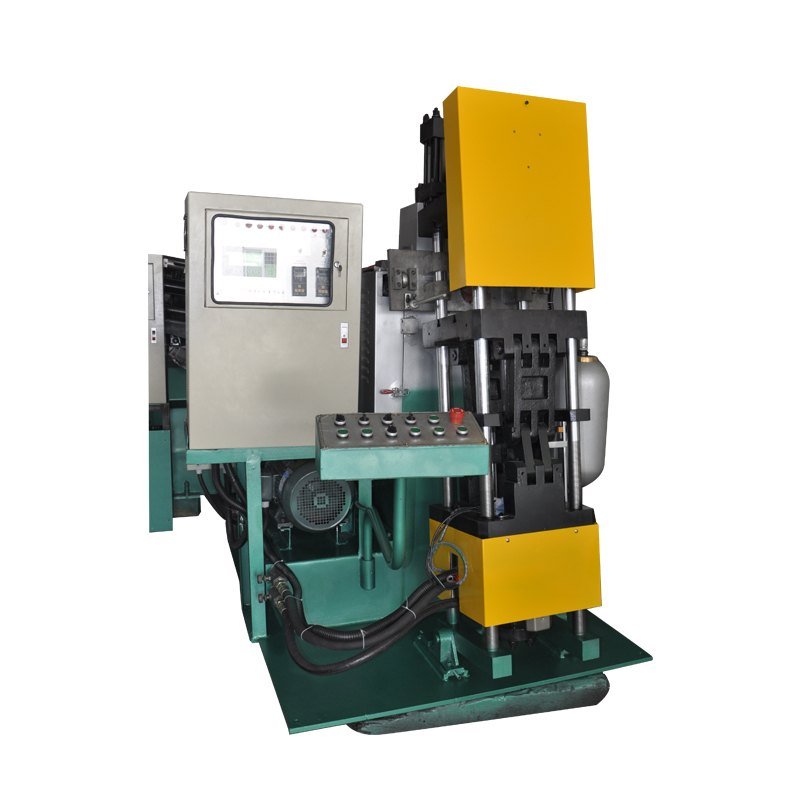
The 15T vertical die casting machine is built for one job that horizontal machines do badly: casting parts with loose inserts — hook eyes, swivels, snaps, eyelets — sitting inside the cavity when the die closes. The mould is clamped horizontally, the shot is pressed from below, and inserts placed by the operator stay exactly where you put them. That is why this machine class is the standard choice for lead fishing weights: jig heads, bullet weights, drop-shot sinkers, cannonball sinkers and bank sinkers.
The furnace sits under the die, the gooseneck dips into the melt and injects upward. Lead melts at 327 °C and zinc at about 420 °C — both well within the machine’s heating range, and the crucible holds roughly 140 kg of lead or 70 kg of zinc, enough for a full shift of small-part casting without refilling.
Why vertical for fishing weights and insert parts
- Inserts stay in place. With the parting line horizontal, hooks and swivels rest on the cavity surface by gravity. A horizontal machine needs hand-held fixtures and still fights insert shift.
- Cavity fully filled from below. The upward shot pushes metal through the thickest section first — good fill on small, dense parts with short flow paths.
- Manual insert loading is the workflow. One operator places inserts, closes… the machine injects, opens, and the part drops out. Cycle time is human-paced, which suits small-batch lure production.
- Small footprint. 2,000 × 1,300 mm — this machine fits in a workshop corner next to a vulcanizing press and a spin caster.
Built around lead — and honest about it
Lead vapour is the real safety topic in this product class, so we say it plainly. The die area is open-topped for natural extraction, and we recommend a point-extraction hood above the die plus general room ventilation — most buyers in the EU and US already have this; we can supply the hood bracket. If your market cannot accept lead at all, the same frame runs zinc: jig heads and sinkers in Zamak are common in retail lure programs.
Main parameters
| Clamping force | 15 t (150 kN) |
| Mould thickness | 130 – 230 mm |
| Tie-bar distance | 235 × 245 mm |
| Tie-bar diameter | Φ35 mm |
| Injection stroke | 60 mm |
| Shot weight (lead / zinc) | 0.5 kg (lead) / 0.25 kg (zinc) |
| Plunger diameter | Φ35 mm |
| Crucible capacity (lead / zinc) | 140 kg (lead) / 70 kg (zinc) |
| Motor power | 5.5 kW (7.5 HP) |
| Accumulator | 10 L |
| Working pressure | 5 – 7 MPa |
| Heating power | 10 kW (heating tubes) + 1 kW (band heaters) |
| Dry cycle time | ≈ 5 s |
| Machine weight | ≈ 1,200 kg |
| Dimensions | 2,000 × 1,300 × 1,500 mm |
| Power supply | 380V, 3-phase, 50 Hz (440V/60 Hz optional) |
All values are the standard configuration. Tell us your part drawing and we confirm shot weight, die thickness and cycle time against it before quoting.
15T or 25T — which one do you need?
Both machines share the same frame concept; the difference is die size and shot weight. The 25T vertical die casting machine takes thicker moulds (up to 260 mm) and larger cavity plates — go 25T if your sinkers are large (cannonball, bank sinker over 100 g) or you want multi-cavity dies for higher output. The 15T is the better buy for jig heads and small weights up to about 30 g, where a bigger machine only adds power consumption and die cost.
Where it fits in a full lure-production line
Most buyers of this machine also run a silicone mould vulcanizing press and a second melting furnace as a shared melt supply. We deliver the complete line — moulds, casting, finishing — as turnkey delivery, installed and commissioned by our engineers.
Turnkey delivery
We ship the machine with export-standard wooden boxing, supply the die design for your part drawing, commission it in your workshop, and train your operator. One supplier accountable for the whole casting line, from mould to finished weight.