
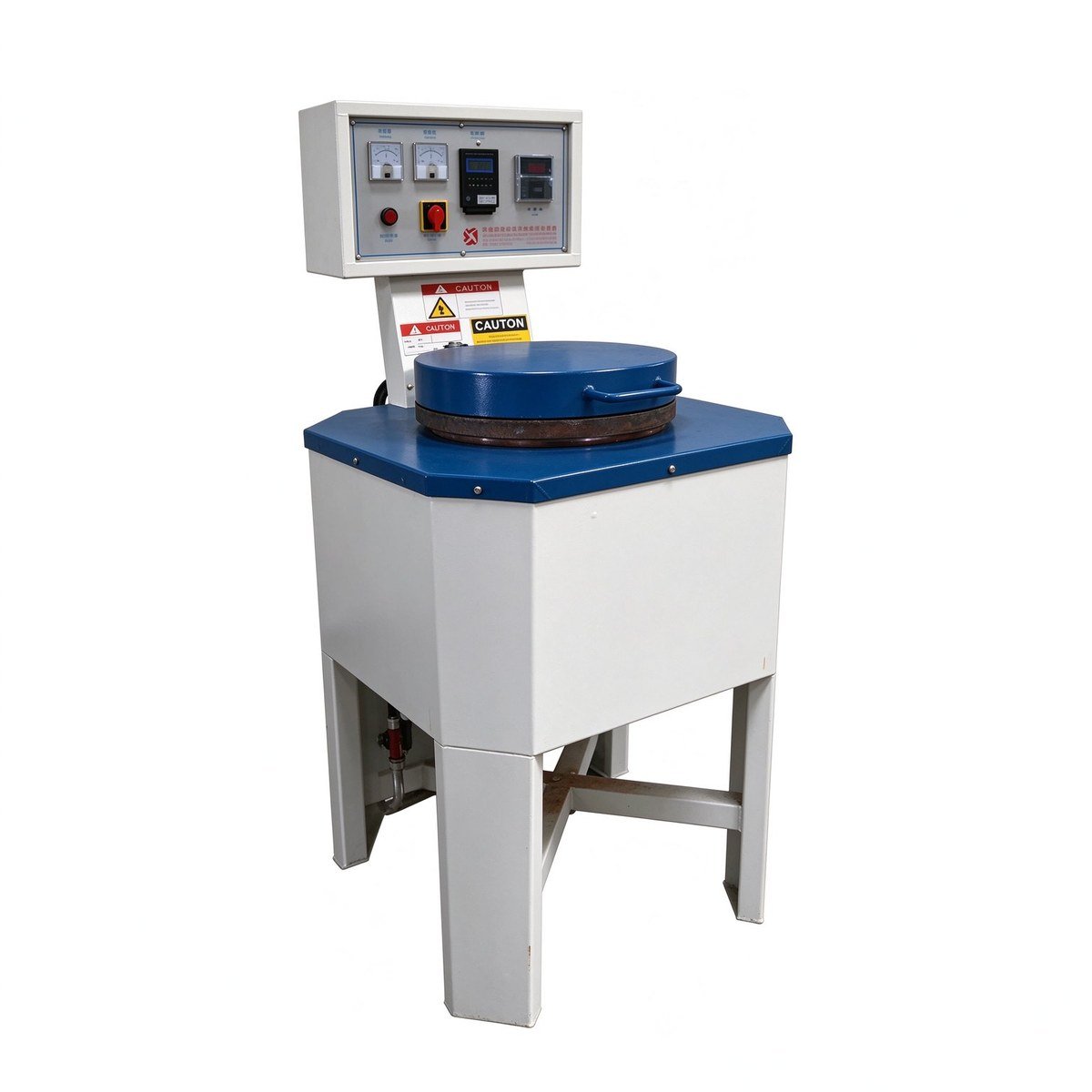
This is a floor-standing electric crucible furnace with a cast iron (grey iron) crucible and a maximum working temperature of 999 °C. It melts zinc alloy, lead alloy and tin–bismuth alloy, and it is the melting end of a spin casting or die casting line: fill it in the morning, set the temperature, and it holds the alloy at pouring temperature all day without anyone watching it.
The cast iron crucible is the reason buyers pick this furnace over a graphite one. Cast iron is heavy, thick-walled and mechanically tough — it survives skimming dross with a steel ladle, dropping in ingots and the odd knock against the pot rim. Graphite and clay-graphite crucibles give cleaner metal but crack when they are handled roughly, and a cracked crucible in a full furnace is a dangerous, expensive afternoon. Cast iron does not conduct heat as fast, so heat-up takes a few minutes longer, but for zinc, lead and tin at 400 – 500 °C it lasts for years and it is cheap to replace when it finally goes.
Alloys it is built for
- Zinc alloy (Zamak 3 / 5 / 8) — pour at 420 – 450 °C; used for buckles, garment hardware, jewellery findings, zipper parts and small castings.
- Lead alloy and pewter — pour at 350 – 420 °C; giftware, figurines, sinkers, trophy components.
- Tin and bismuth alloy — pour at 250 – 320 °C; low-melting patterns, fusible cores, lead-free pewter, souvenir castings.
- Not recommended for aluminium — molten aluminium attacks and contaminates an iron crucible, so if you need to run aluminium, ask for the graphite-crucible version instead. Being honest about this saves you a ruined pot.
Main parameters (typical)
| Machine type | Electric resistance crucible melting furnace, floor-standing |
|---|---|
| Max temperature | 999 °C |
| Working temperature | Zinc 420 – 450 °C · lead / pewter 350 – 420 °C · tin / bismuth 250 – 320 °C |
| Crucible | Cast iron (grey iron), thick wall, replaceable |
| Crucible capacity | approx. 90 kg zinc alloy (approx. 150 kg lead–tin alloy) |
| Heating element | Resistance wire wound around the crucible, embedded in the refractory |
| Insulation | High-alumina refractory brick + ceramic fibre blanket + air gap between shell and lining |
| Temperature control | Digital PID with 24-hour programmable segments, ±5 °C |
| Control panel | Voltmeter, ammeter, digital thermostat, timer, start / stop and emergency stop |
| Heat-up time | 40 – 50 minutes from cold to 450 °C |
| Power consumption | 8 – 9 kWh while melting; roughly one third of rated power while holding temperature |
| Rated power | 12 kW |
| Power supply | 380 V / 3-phase / 50 Hz (220 V single-phase version available) |
| Pouring | Manual tilt by hand lever; fixed-body ladle-pour version also available |
| Safety | Over-temperature alarm and power cut-off, earth leakage protection |
| Dimensions | approx. 620 × 780 × 1250 mm |
| Net weight | approx. 180 kg |
| Warranty | 12 months on the furnace body, control box and heating circuit |
What the control panel actually does
The panel is not decoration. It carries a voltmeter and an ammeter, so you can see at a glance whether a heating element has failed — the current drops before the metal does. The digital thermostat holds the set point, and the programmable controller lets you set a 24-hour schedule: for example heat to 450 °C at 07:30, drop to 420 °C overnight, or start warming two hours before the shift so nobody stands around waiting.
Why the running cost is lower than it looks
- It only draws full power while melting. Once the metal is at temperature the controller cuts in and out and the furnace sits at roughly a third of rated power.
- The lining is the efficiency. Refractory brick, a ceramic fibre blanket and an air gap in series mean the outer shell stays comfortable to touch — heat that stays in the pot is heat you do not pay for twice.
- A full pot is cheaper than a half pot. A deep melt bath loses proportionally less heat from the surface, and one melt a day costs less than three.
Where it fits in a casting line
This is the furnace that feeds a spin casting machine. If you are starting out or your orders change every day, pair it with the manual centrifugal spin casting machine — lowest entry cost, and the operator judges the pour by eye. If you want the speed and repeatability typed into a panel, look at the semi-automatic machine, or the semi-automatic vacuum version if the castings will be polished or plated. For a product that runs continuously, the fully automatic machine is the one that lets a single operator watch several units.
Note that most spin casting machines already have their own built-in melting pot. This stand-alone furnace is for shops that want a larger reservoir of metal, that run several machines from one melt, or that need a second alloy kept ready — it is a buffer and a reservoir, not a replacement for the pot on the machine.
Turnkey delivery
Supplied as a working unit, not a crate:
- Cast iron crucible fitted and seasoned, spare crucible available as an option
- Commissioning and first melt in your workshop, including a temperature check against a hand pyrometer
- Operator training: charging, skimming, fluxing, and how to read the ammeter for element failure
- Spare heating elements and a thermocouple kept in stock, plus lifetime remote support
Ask for a quotation
Tell us which alloy you melt, the pot size you need and your supply voltage (220 V single phase or 380 V three phase). We will confirm the crucible capacity that suits your shift, the spare crucible and element price, and a delivery schedule — usually within one working day.