
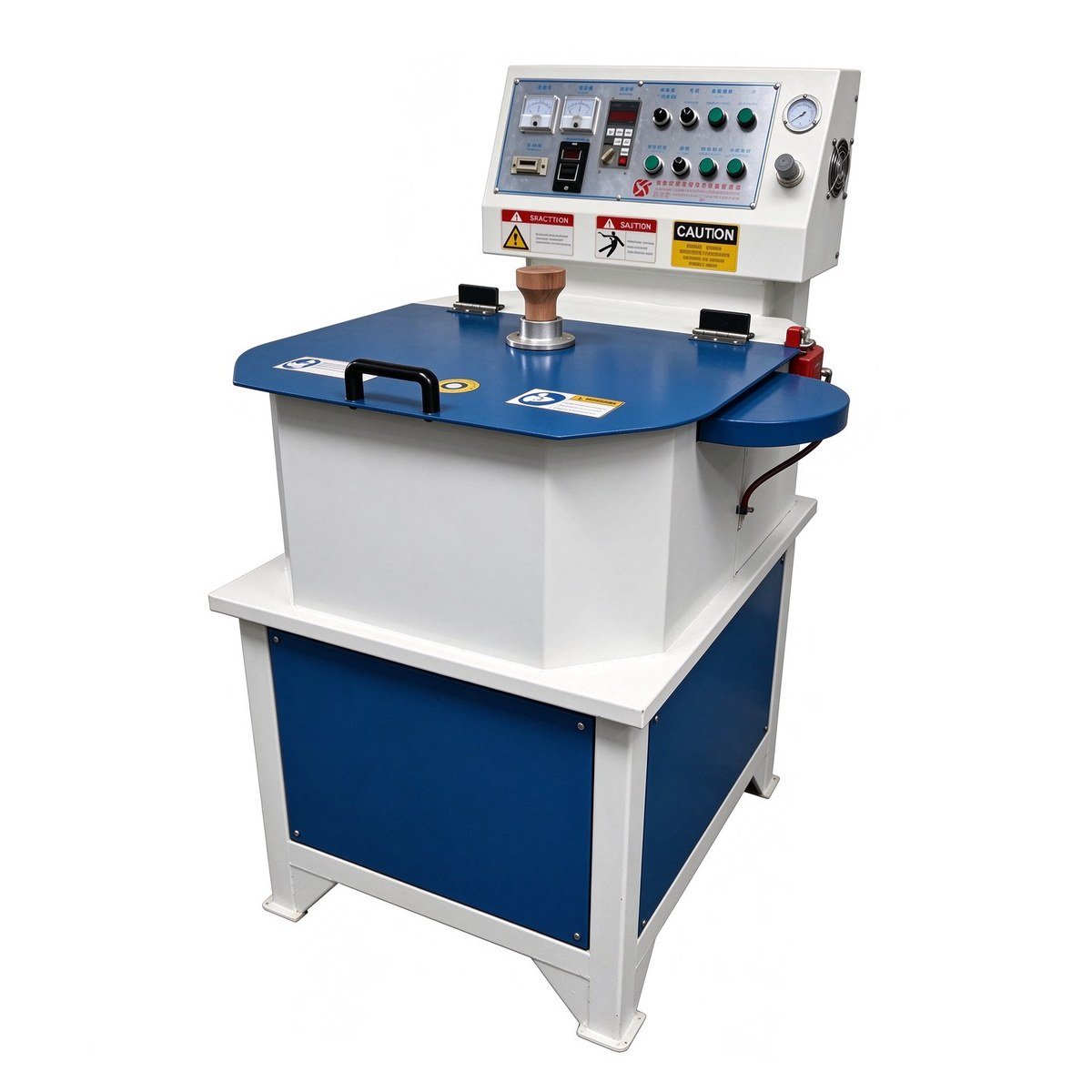

This is the manual version of our furnace-integrated spin casting machine: the melting furnace sits in the base, the spinning table sits under the blue safety lid, and the operator pours the metal by ladle into the centre sprue. Everything else is machine-controlled — the table speed is set on the potentiometer and held by the drive, and the lid lifts on gas springs so the mould can be changed with one hand.
The layout is the classic benchtop configuration used across the jewellery and hardware trade: a steel frame with a weighted base, a dual braking system (electronic brake plus mechanical drum brake) so the table stops in under two turns instead of coasting, and a PID temperature controller that holds the melt within ±5 °C. It is the lowest-cost way to put a complete casting cell on the floor, and the easiest to keep running with local spare parts.
Built for
- Zinc alloy (Zamak 3 / Zamak 5) jewellery, buckles and garment hardware
- Pewter, tin and lead alloy giftware, figurines and souvenirs
- Badges, medals, keychains and small decorative fittings
- Sample and short-run production where moulds change every few hours
Main parameters (typical)
| Machine type | Manual centrifugal (spin) casting, furnace integrated |
|---|---|
| Spin speed | 0 – 1400 rpm, stepless (potentiometer or foot pedal) |
| Spin drive | DC motor with variable speed control |
| Braking | Dual system — electronic brake + mechanical drum brake |
| Mould diameter | 6″ – 12″ (150 – 300 mm) |
| Mould thickness | 0 – 100 mm |
| Mould stations | Single station |
| Crucible capacity | approx. 60 kg (zinc alloy) |
| Melting | Electric resistance furnace, built into the machine base |
| Max melt temperature | 600 °C (typical pour 420 – 450 °C for Zamak) |
| Temperature control | PID, ±5 °C |
| Pouring | Manual ladle into the centre sprue |
| Safety lid | Gas-spring assisted lift lid with interlock |
| Air supply | 0.4 – 0.7 MPa compressed air required |
| Spin motor | 1.5 kW DC |
| Connected load | approx. 12 kW |
| Power supply | 380 V / 3-phase / 50 Hz (220 V single-phase version available) |
| Dimensions | approx. 900 × 800 × 1300 mm |
| Machine weight | approx. 350 kg |
| Output | approx. 40 – 80 casts per hour, depending on operator and mould |
How the manual cycle runs
- Melt — the alloy is loaded into the crucible in the base; the PID controller brings it to the set temperature and holds it there.
- Load — the lid is lifted on its gas springs, the rubber mould is located on the table and the lid is closed and latched.
- Spin — the operator sets the speed on the potentiometer (the drive holds it steady) and starts the table.
- Pour — metal is taken from the crucible with a ladle and poured into the centre sprue while the table is turning.
- Stop and unload — the dual brake brings the table to rest quickly, the lid is opened and the mould goes to the cooling fan or the bench.
Manual or automatic — which one do you actually need?
We build both, so here is the honest split. Choose this manual machine when you run many small orders, change products often, or want the lowest entry cost and the simplest maintenance. Choose the automatic version when one product runs for long shifts and you want a fixed shot weight every cycle, one operator running several machines, and no ladle work at all.
Why buyers choose the manual configuration
- Lowest entry cost — a complete melting and spinning cell for a fraction of an automatic line.
- Flexible for short runs — nothing to reprogram; change the mould, change the speed, carry on.
- Furnace in the base — no separate melting bench, no transfer ladle walking across the shop floor.
- Dual braking, gas-spring lid — the table stops fast and the lid stays up on its own, which is what keeps a manual machine safe in daily use.
- Simple upkeep — standard heater elements, standard bearings, standard brake shoes; any local workshop can service it.
Turnkey delivery
Every machine is supplied as a working line, not a bare machine:
- Rubber mould making — master pattern, vulcanising and first article approval
- Installation, commissioning and trial production in your workshop
- Operator training and a written process parameter sheet per product
- Spare parts package (crucible, heater elements, brake shoes, lid seal) and lifetime remote support
Ask for a quotation
Send us the part drawing or a photo of the product, the alloy you cast and your target output per shift. We will reply with the right mould diameter, crucible size, mould cost and a delivery schedule — usually within one working day.