
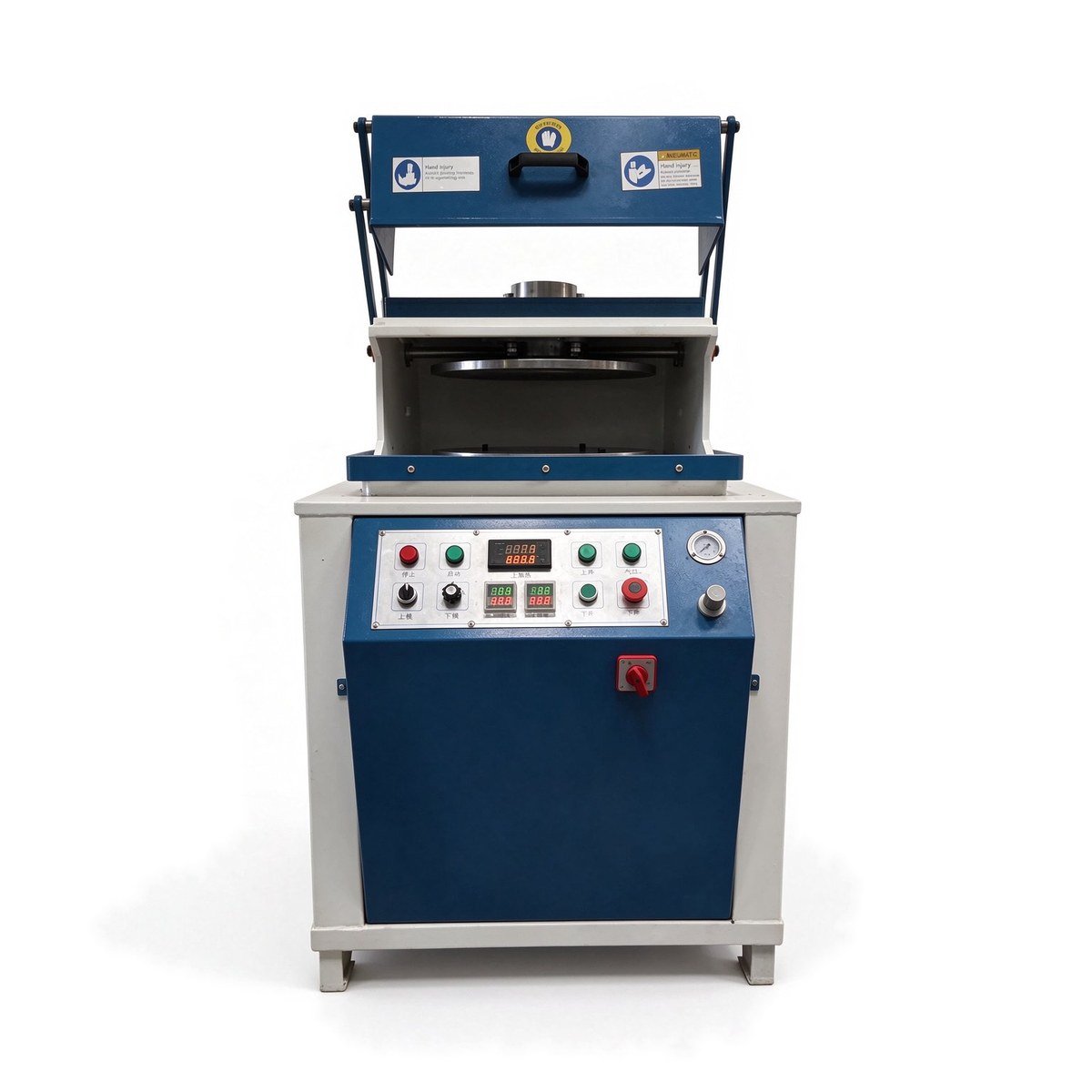
This is the same semi-automatic spin casting machine without the vacuum system: pneumatic lid, digital speed and spin timer, pneumatic dosing at a set pressure and an electronic brake. It does everything a manual machine does, except the parts that make the operator tired — no lifting a heavy lid by hand, no judging the speed by ear, no waiting for the table to coast down.
Without a vacuum pump there is nothing extra to seal, service or power, so this is the version to specify when the casting does not have to be cosmetically perfect: thick sections, hidden parts, components that get machined or painted afterwards. Same frame, same control panel, same cycle — the air simply stays in the chamber.
Built for
- Zinc alloy (Zamak 3 / Zamak 5) jewellery, buckles and garment hardware
- Pewter, tin and lead alloy giftware, figurines and souvenirs
- Badges, medals, keychains and small decorative fittings
- Rubber-mould casting shops moving up from a fully manual machine
Main parameters (typical)
| Machine type | Semi-automatic centrifugal (spin) casting, single mould station |
|---|---|
| Spin speed | 50 – 1400 rpm, stepless in 10 rpm steps, digital display |
| Spin timer | Digital, set per mould and stored for repeat runs |
| Mould diameter | 9″ – 12″ (230 – 300 mm); 14″ – 18″ on request |
| Mould thickness | 0 – 120 mm |
| Mould stations | Single station with automatic mould detection |
| Vacuum system | Not fitted — standard (non-vacuum) model |
| Crucible capacity | approx. 80 kg (zinc alloy) |
| Melting | Electric resistance furnace, PID controlled |
| Max melt temperature | 600 °C (typical pour 420 – 450 °C for Zamak) |
| Temperature control | PID, ±5 °C |
| Injection | Pneumatic dosing, 0 – 7 kg/cm² adjustable |
| Lid operation | Automatic pneumatic open / close |
| Safety | Dual interlock on the lid + electronic emergency brake |
| Air supply | 0.6 – 0.8 MPa compressed air required |
| Drive power | spin motor 1.5 kW |
| Power supply | 380 V / 3-phase / 50 Hz (220 V single-phase on request) |
| Dimensions | approx. 900 × 800 × 1400 mm |
| Machine weight | approx. 200 kg (approx. 350 kg crated) |
| Output | approx. 60 – 120 casts per hour, depending on mould and alloy |
How the semi-automatic cycle runs
- Load — the rubber mould is placed on the table; the sensor confirms it is seated and positioned for balance.
- Close — the lid closes automatically and latches.
- Spin and inject — the table ramps to the programmed speed and the pneumatic cylinder injects the set dose at the set pressure.
- Hold — the table keeps turning for the programmed time while the metal solidifies.
- Brake and unload — the electronic brake stops the table, the lid lifts and the mould comes off for the cooling bench.
Why buyers choose the non-vacuum version
- Lower purchase price — the pump, the chamber sealing and the vacuum plumbing are gone.
- Fewer maintenance points — no pump oil, no vacuum seals, no gauge to watch; nothing to leak.
- Lower connected load — 1.5 kW of drive instead of 2.7 kW, which matters where the workshop supply is tight.
- Same automation as the vacuum model — automatic lid, digital speed and timer, pneumatic dosing and electronic brake are all still there.
- Right for non-cosmetic parts — if the casting is machined, painted or hidden, vacuum adds cost without adding sellable quality.
Standard or vacuum — which one do you need?
Choose this standard model when the part is thick-sectioned, hidden inside an assembly, or finished by machining, painting or plating that will remove the surface anyway. Choose the vacuum version when the casting will be polished or plated as-cast — porosity that never shows on a raw part becomes a pit or a blister after polishing, and that is exactly what the vacuum chamber prevents.
Turnkey delivery
Every machine is supplied as a working line, not a bare machine:
- Rubber mould making — master pattern, vulcanising and first article approval
- Installation, commissioning and trial production in your workshop
- Operator training and a written process parameter sheet per product
- Spare parts package (crucible, heater elements, brake shoes, lid seal, vacuum pump seals) and lifetime remote support
Ask for a quotation
Send us the part drawing or a photo of the product, the alloy you cast and your target output per shift. We will reply with the right mould diameter, crucible size, mould cost and a delivery schedule — usually within one working day.